Direct answer
Evaluate stretch woven on recovery after wear and wash, crease memory for travel, pilling on friction zones, and pocket load distortion. Lock fibre, elastane %, GSM and finish before colour — then re-check recovery on the washed sample. For procurement: freeze the measurable checks (GSM or construction, wash protocol, branding method, MOQ from 150 pcs per style/color, remake timing approximately 7–9 working days after confirmation, and Incoterm preference) on one commercial sheet before deposit. Adjective-only briefs reopen sampling. Sample-led OEM means no shelf stock pretending to be development — remake, approve, then open colour. That sequence protects both calendar and claim risk across UK, EU, US and AU programmes. If marketing pressure asks to skip a gate, record the refusal in writing; the season review will thank you when shade, fit or documentation holds.
| Check | Why it matters | Pass signal |
|---|---|---|
| Recovery | Prevents knee/seat bagging | Returns cleanly after sit/walk + wash |
| Crease memory | Travel appearance | Creases drop within a short hang time |
| Pilling | Thigh and pocket abrasion | Acceptable grade on agreed method |
| Pocket load | Phone carry | No permanent distortion at entry |
| Opacity | Light colours / stretch | No show-through at wear extension |
What stretch woven must prove
For men’s travel pants and shorts shells, stretch woven is judged on recovery after sit/walk, crease memory, surface pilling and how pockets carry a phone without distorting the silhouette.
Hand and recovery protocol
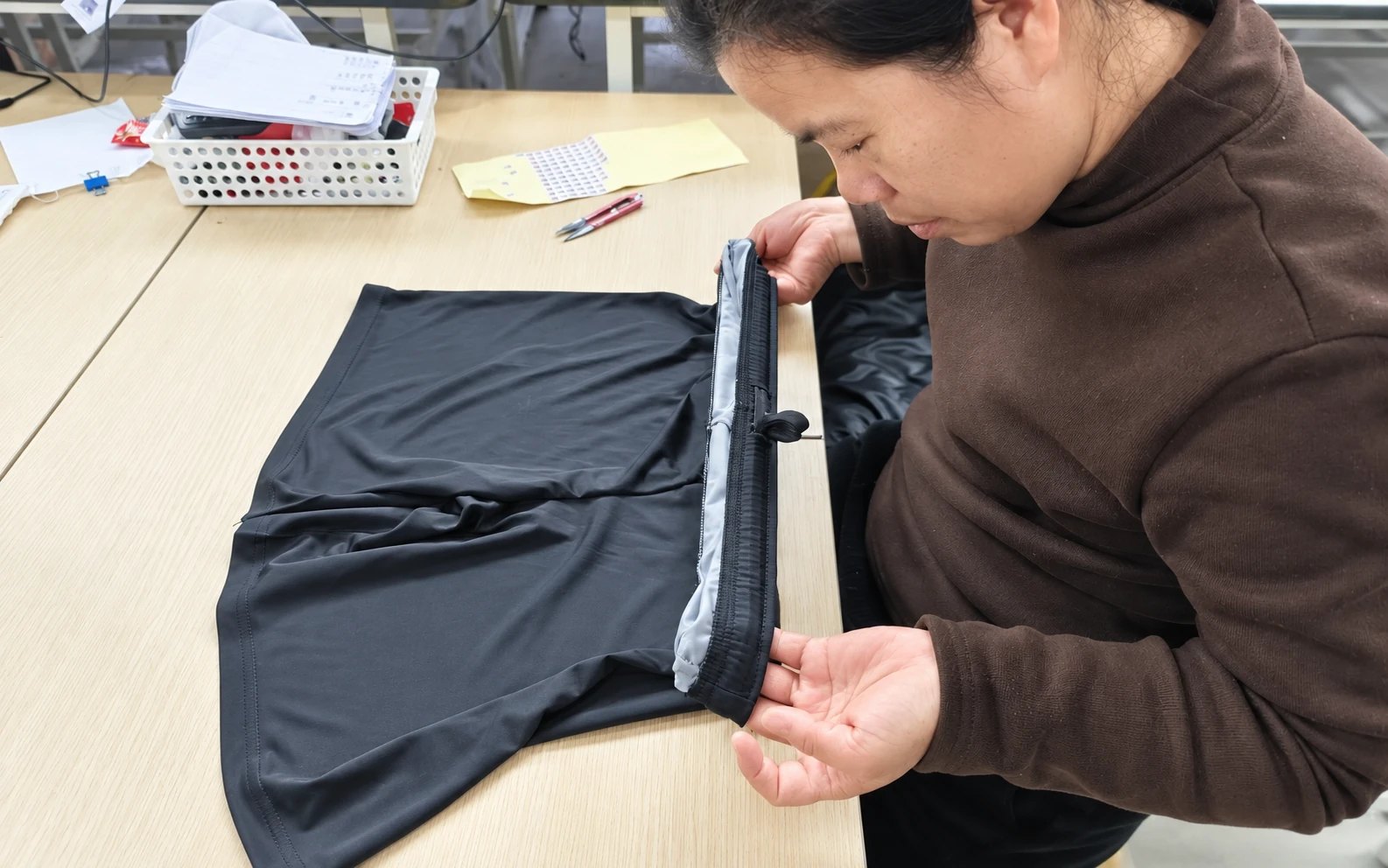
Pull warp and weft to a practical wear extension, hold, release, and check bagging at knee and seat. Record recovery after wash — not only on greige.
Crease and travel realism
Pack the fabric or pant overnight, then evaluate crease depth under normal light. Travel programmes fail on airport creases more often than on gym stretch.
How ELEVIA shortlists
We map fibre (nylon vs polyester), elastane %, GSM and finish against end use, then confirm stretch recovery and pilling language at sampling against recognised test methods.
Why stretch woven fails in the field
Men’s travel pants and shorts shells fail less often on “not enough stretch” and more often on bagging at the knee, deep airport creases, pocket distortion from a phone, and pilling on the inner thigh. A fabric that feels premium in a quiet showroom can look tired after one packed flight. Evaluation must include wear simulation and wash — not only a hand pull on greige. If your programme sells commute-to-train versatility, crease memory belongs on the same checklist as elastane percentage.
A practical recovery and crease protocol
Extend warp and weft to a realistic wear load, hold, release, and photograph recovery at knee and seat after sitting. Repeat after the wash protocol you will put on the care label. For travel realism, pack a pant or fabric length overnight and grade crease depth under normal indoor light after a short hang. Record results in the tech pack so mill A and mill B are compared on the same method. Without a written protocol, every stakeholder will “feel” something different and sampling never closes.
Fibre, GSM, finish and pocket load
Nylon vs polyester changes abrasion, noise and hand; elastane % changes recovery and growth; GSM and finish change drape and crease. Pocket load is a garment test: load a phone, walk, sit, and check permanent distortion at the pocket entry. Opacity at wear extension matters for light colours. Certifications and chemical scopes (when required for EU/UK programmes) should be scoped per order — do not assume a brochure OEKO-TEX claim travels with every dye lot.
Linking fabric approval to the block and MOQ
Approve the stretch woven against the pant or short block you will bulk, not against a generic swatch. Library remake timing is typically approximately 7–9 working days after confirmation; garment MOQ from 150 pcs per style/color still needs shade and size-curve discipline. If you change finish or elastane mid-season, reopen recovery and crease checks. Stock shade vs custom dye remains a separate commercial fork — stretch performance does not replace colour continuity rules.
What to put on the RFQ
End use (travel pant / shorts shell), target hand, climate, stretch/recovery expectations, pilling concern zones, pocket load requirement, destination market for docs, and whether FOB or DDP will carry the first bulk. Attach a reference pant when possible. ELEVIA shortlists TransitStretch-class platforms and confirms stretch recovery and pilling language at sampling against recognised ISO/ASTM method families when the programme requires them.
Buyer mistakes that reopen fabric
Approving a soft hand without wash recovery; ignoring crease on travel bottoms; mixing shell and liner stretch claims; changing elastane % after PPS without a new gate; and assuming a stock shade path cannot pill. Write fail criteria before sampling so mills and factories compete on the same scorecard. That is how stretch woven programmes close on schedule instead of cycling opinions.
Common mistakes
- Approving hand-feel without a washed recovery check
- Ignoring crease behaviour on travel bottoms
- Mixing shell and liner stretch language as if they were one fabric
Buyer advice
- Write recovery and crease into the tech pack as measurable checks
- Compare nylon vs polyester on abrasion and noise, not marketing names
- Link fabric approval to the pant/short block you will bulk
- Write recovery and crease protocols into the tech pack
- Test pocket load on the actual block, not only fabric
- Re-check recovery after wash before PPS
- Scope chemical docs to destination market — do not invent mill logos
Buyer FAQ
Questions procurement usually asks next
Is stretch woven always better than knit for travel pants?
Often for crease and structure — not always for soft gym hand. Match construction to end use.
Do you publish mill brand names?
We shortlist against performance and certificates. Public mill names are shared under NDA when commercially appropriate.
Where do you cite test methods?
See /sourcing-standards/ for OEKO-TEX, GRS, ISO and ASTM references we use in programme language.
Evaluate styles
From this insight → library products
Open a sample path on a live block — then confirm fabric platform and MOQ on the RFQ.
Downloadable library summary: Lookbook PDF. Legal entity: Guangzhou Elevia Apparel Technology Co., Ltd.